DONNA LOWSON
Artist Researcher.
Material remembers where the archive forgets

Elastic Hairwork Circulation and the Brontë Collection (J13 & J43)
Study Visit Reflections: Brontë Parsonage Museum
Donna Lowson, April 2026
This research traces a structure across time.
Not as a fixed origin, but as movement between object, advertisement, and instruction.
Objects in the Archive
Two hair bracelets within the Brontë collection, J13 and J43, form the basis of this comparison.
Both are attributed as Brontë-associated objects.
Both demonstrate a braided structure that produces its own tension.
There is no clasp.
No external fastening.
Closure is held within the braid itself.
A Self-Tensioning Structure
The double elastic bracelet braid is, across museum collections, archival traces, and practice-based reconstruction, the only hair work structure encountered that sustains itself in this way, without the need for binding, boiling, or baking to achieve elasticity.
It closes through its worked structure, holding firm on the wrist through its interlacing.
What appears visually delicate is structurally precise.
Printed Instruction
The same braid later appears in Self Instructor in the Art of Hair Work (1867)
by Mark Campbell.
Here, the structure is codified, translated into a diagram, instruction,
and repeatability.
What was once tacit becomes legible.
Earlier Circulation


Figure 3: Self-Instructor in the Art of Hair Work, Mark Campbell, 1867.
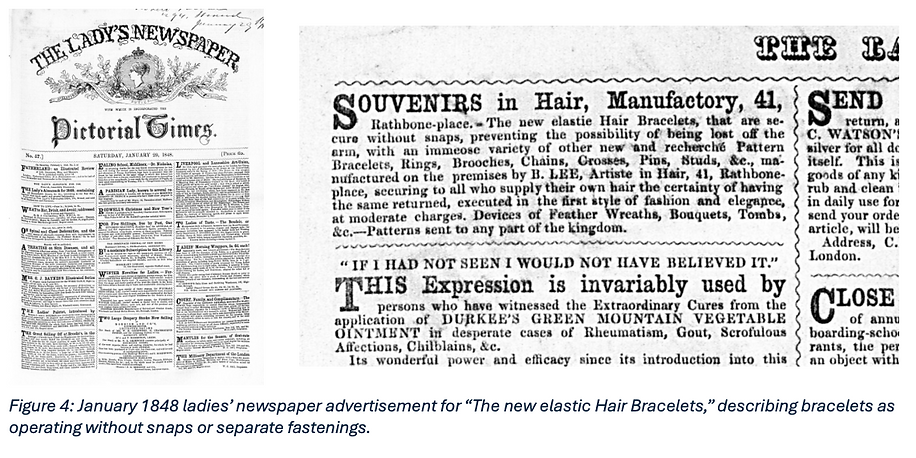
An earlier trace appears in January 1848:
An advertisement for “the new elastic hair bracelets”.
The language is precise, describing the bracelets as operating without snaps or separate fastenings.
This corresponds directly with the self-tensioning structure observed in the Brontë objects and later instructional texts.
A Timeline in Proximity
-
January 1848 Elastic hair bracelets were advertised
-
December 1848 Death of Emily Brontë
-
May 1849 Death of Anne Brontë
-
March 1855 Death of Charlotte Brontë
-
1867 Publication of Self Instructor in the Art of Hair Work
Material Proximity
The 1848 advertisement sits within the lived timeframe of the Brontë sisters.
Elastic hair work is not a later Victorian refinement alone
it is already named, marketed, and circulating within their cultural moment.
The bracelets in the collection do not sit outside this context.
They are part of it.
On Circulation and Codification
Taken together, objects, print culture, and reconstructed technique,
These materials point to a broader circulation of elastic hairwork practices in the mid-nineteenth century.
Method
This research emerges through a material-led approach:
-
direct study of museum objects
-
archival research across print culture
-
reconstruction through practice
Knowledge is not only read, It is made, handled, and tested.